
The “Science” Behind Technology Marketing
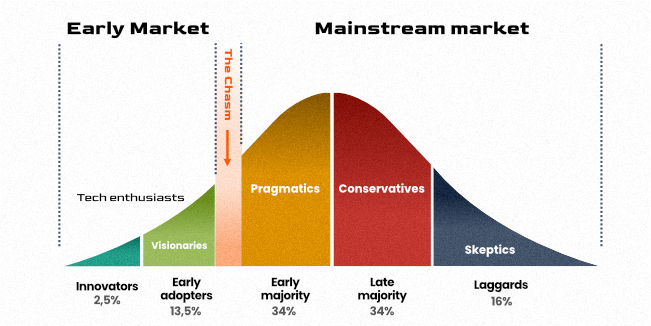
For our purposes, picture the person in your life that is always getting the latest and greatest. If there is a new iPhone, this person has it. If there is something newer/better/shinier than an iPhone, this person has it and is part of the “early market” for that technology.
In the broadband space, these are the handful of homes that subscribe to multi-gigabit connections. They don’t need that connectivity and may not even have the hardware that works with that connectivity – but they need it. Innovators and early adopters make up approximately 16% of the market for any technology relevant to a given group. These individuals sometimes buy for status, sometimes they just have a burning desire to be first… it’s a group that requires little to no marketing beyond awareness to motivate purchase.
The Chasm and Your Broadband Service
Geoffrey A. Moore’s book Crossing the Chasm explains how difficult it was to move a product from innovators/early adopters to a majority stage.
Moore calls the innovators “visionaries” and the group after the chasm the pragmatists. The key to a successful technology rollout is not getting the visionaries on board, but rather, winning over the pragmatists. Most technology requires a change or an action for adoption. And to get the masses to start adopting, there needs to be a compelling case to motivate action.
Rather than motivating purchase, promoting speed and price assumes that everyone is already across the chasm. That they, unanimously and unequivocally, accept faster broadband is better… and worth the price.
We know from study after study that this is not the case. In both urban and rural settings, many homes are choosing no connectivity over basic connectivity due most often to price. And many ISPs find their cheapest/slowest service tier to be their leading tier. The chasm may have been crossed for broadband – but the case remains to be made for faster, more expensive service tiers.
What Does Better Broadband Mean to Me?
Many great technologies fall flat when trying to cross the chasm because of a simple fact: people buy benefits, not features. Consumers purchased the iPod not because it was new technology, but because it was convenient to carry 1000s of songs. It’s successor the iPhone enables productivity and mobility. Life benefits.
For any technology to become much more than a “shiny object,” but as a vehicle for a better, more productive life, there’s some marketing needed. And that marketing is lifestyle centric. Don’t assume consumers understand why they need faster connections. Yes, the 2020 pandemic did a lot of work for broadband, but there are still stories and use cases to tell. There’s still (marketing) work to do.
Marketing should lead with the benefits of smart homes, better gaming, and multiple home offices running concurrently. Marketing to businesses should focus on availability, cloud solutions, and specific business services.
It’s easy to clap a speed and a price on a flyer and call it marketing. Tell your story, make a compelling case, and create rabidly loyal customers.
Marketing to your own install base what they can and should be doing with your service will also reduce churn…
READY TO WORK WITH THE broadband marketing TEAM?
We would love to heqr from you. Reach out and we will get right back to you.
READY TO WORK WITH THE DCORE TEAM?
We would love to heqr from you. Reach out and we will get right back to you.